
An overlooked major cost item: factory building ventilation
For large-scale facilities such as warehouses, factories, and logistics centers, ventilation and cooling often represent the second-largest electricity expenditure, following that of production equipment. Traditional solutions, which rely on numerous wall-mounted fans or central air conditioning systems, not only consume substantial amounts of electricity but also deliver inconsistent performance. Industrial High-Voltage Linear Systems (HVLS), as a next-generation ventilation solution, are now helping enterprises worldwide significantly reduce their air conditioning and ventilation costs.
Data Comparison: HVLS Fans vs. Traditional Solutions
Consider a standard warehouse of 10,000 square meters with a ceiling height of 8 meters as an example:
· Traditional solution: approximately 50 wall-mounted fans, each with a power rating of 0.15 kW, resulting in a total power consumption of 7.5 kW, operating 10 hours per day
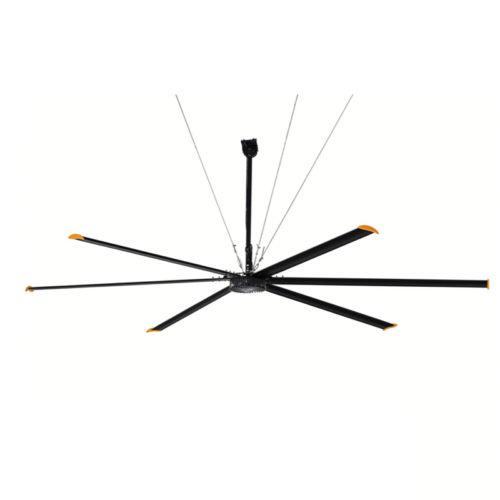
· HVLS Solution: Requires only four large fans, each with a diameter of 7.3 m, each rated at 1.5 kW, for a total power of 6 kW, operating 10 hours per day.
At first glance, the difference in power output may seem negligible; however, the critical factors are coverage area and comfort. A single HVLS ceiling fan can generate a low-speed airflow that covers 600–1,000 square meters, providing a uniform natural breeze across the entire body; in contrast, 50 wall-mounted fans can only create localized airflow, with virtually no far-field effect.
True energy savings come from “reducing air conditioning use.”
The greatest energy-saving benefit of HVLS fans lies not in their own power consumption, but in their ability to significantly reduce the operating time of air conditioners and cooling fans. By promoting air circulation throughout the entire plant, HVLS fans can:
· Reduces the perceived temperature by 5–8 °C, ensuring you no longer need to use your air conditioning during spring and autumn.
· When using the air conditioner, raising the set temperature by 2–3 °C can reduce energy consumption by approximately 20–30%.
Let’s do the math: How long will it take to recoup your investment?
Taking four HVLS fans as an example, assuming each fan operates for an average of 10 hours per day and the industrial electricity rate is 1 yuan per kWh:
· Power consumption of the HVLS fan itself: 6 kW × 10 hours × 30 days = 1,800 kWh/month
· Air conditioning energy savings: Based on an estimated 30% reduction in air conditioning operation, monthly electricity savings amount to approximately 3,000–5,000 yuan.
· After deducting the fan’s own electricity costs, the monthly net savings amount to approximately 2,000–3,000 yuan.
Typically, the payback period for an HVLS fan system ranges from 1.5 to 2.5 years, while the service life of the fans can exceed 10 years. This means that the subsequent 7–8 years yield almost pure profit.
Other easily overlooked benefits
· Enhance employee comfort and increase work efficiency by approximately 10–15%
· Reduce the risk of goods becoming damp or moldy, thereby minimizing storage losses.
· The operating noise level of the PMSM motor is below 50 dB, and it does not interfere with communication within the plant area.
· The fan blades have a large surface area but operate at a low rotational speed (approximately 50–80 rpm), making it significantly safer than a high-speed small fan.
sum up
HVLS industrial fans are not merely “large ventilation fans”; they are precision-engineered space ventilation and energy-saving systems. If your factory incurs annual electricity costs for air conditioning and ventilation exceeding 50,000 yuan, investing in an HVLS fan will almost certainly pay for itself. Contact us to obtain a customized energy-saving assessment report tailored to your facility.